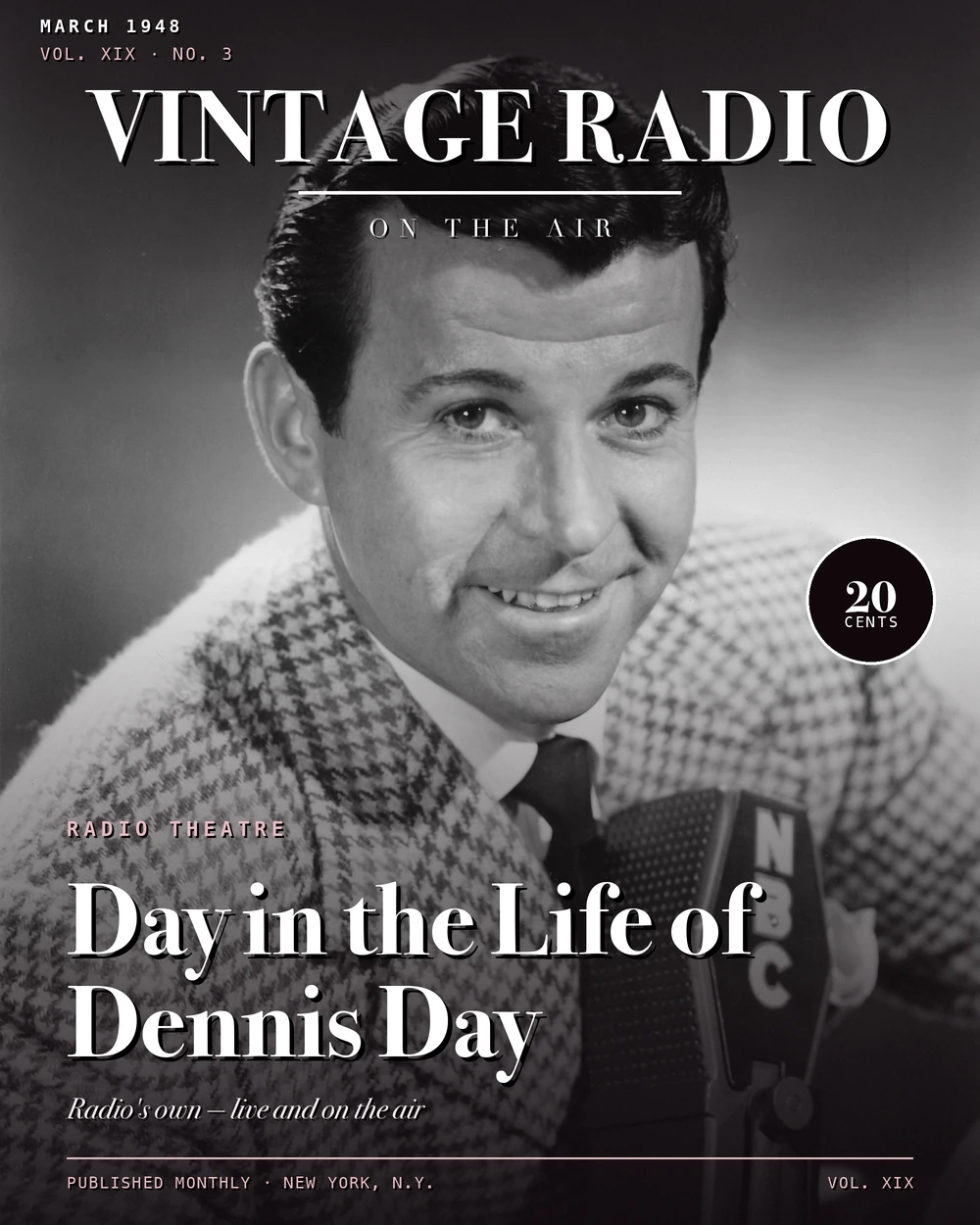
A Day in the Life of Dennis Day
From Jack Benny's Foil to His Own Show
Dennis Day spent most of radio listeners' awareness standing next to Jack Benny, delivering his catchphrase "Gee, Mr. Benny!" in that wide-eyed, guileless way that had made him a fixture on The Jack Benny Program since 1939. He had replaced tenor Kenny Baker, who had grown tired of being used as a featherbrained foil and given notice. Day slipped into the role so naturally that it became his calling card — the naive Irish tenor who could be led anywhere and surprised by everything. By 1946, the question was whether that character could carry its own half-hour.
The answer turned out to be yes, for five years. A Day in the Life of Dennis Day premiered on NBC on October 3, 1946, and ran through June 30, 1951. The pilot, titled "Masquerade Ball," was produced on April 18, 1946. Colgate-Palmolive heard it, signed on as sponsor — advertising Lustre Creme Shampoo — and the series was developed as a standalone NBC program. The premiere episode, which aired a month later than originally scheduled, featured Jack Benny and announcer Don Wilson as guests, its story hinging on how Dennis got his own radio program. Benny could afford to be generous; it became a running gag on his own show that both Dennis Day and Phil Harris each had two programs while Benny had only one.
The real Dennis Day was Owen Patrick Eugene McNulty, born May 21, 1916, in the Throggs Neck/Clason Point section of the Bronx to Irish immigrants Patrick and Mary McNulty. His father worked as a factory electric power engineer. Day attended Cathedral Preparatory School and Seminary in New York City, then Manhattan College in the Bronx, where he sang in the glee club. He originally planned a law career and started singing to earn tuition money. In 1939, performing as "Gene McNulty," he sang on network radio with bandleader Larry Clinton on broadcasts aimed at collegiate audiences, often recorded on college campuses, and won an audience poll as a favorite vocalist. Mary Livingstone, Jack Benny's wife, heard him during a New York visit, took a recording to Benny, and Benny traveled to New York to audition him. Day debuted on The Jack Benny Program on October 8, 1939, his first recorded song on the show being "Goodnight My Beautiful." He was marketed and billed as "America's Favorite Irish Tenor."
The World of Weaverville
The show planted its fictional Dennis Day in the small town of Weaverville, where he boarded with the Anderson family. The earliest format had him working as a singing soda jerk, and the show made a running joke of insisting that this Dennis Day was not the same one who appeared with Jack Benny — in one episode, a character asks Dennis if he ever listens to the Benny program, and Dennis replies he's "never home." The comedy ran on Dennis's familiar character traits: naive, addlebrained, usually broke, and perpetually trying to impress his girlfriend Mildred Anderson and her parents, who generally preferred her other suitor, a character named Victor Miller, described plainly as a heel.
The standard episode format was built around Dennis's voice as much as his comedy. Each half-hour opened with a song by Dennis Day, moved into the first half of the plot, paused for a second song, concluded the story, and ended with a third closing song. Later in the run, Dennis shifted to working at Willoughby's store, and around 1950 the show took on a variety format with Dennis as master of ceremonies. The format changed several times over five years, but the character himself stayed consistent — the wisecracking innocent who could be wrong about nearly everything. Surviving episode titles give a fair sense of the weekly territory: "Dennis Is Mistaken for a Missing Heir," "Dennis Becomes Irresistible to Women," "The Elopement," "Dennis Asks for a Raise and Is Let Go," "Dennis Is Mistaken for a Bank Robber," "Dennis Runs for Mayor," "Dennis Impersonates a Big Railroad Boss," "Mrs. Anderson Opens a Dress Shop," and "Dennis Becomes a Drama Critic."
The Anderson Family and the Rest of the Cast
The Anderson household gave the show its comedic spine. Clara Anderson, the domineering mother and landlady, was played by Bea Benaderet, who was so busy during this period that the press nicknamed her "Busy Bea." She was simultaneously playing Gertrude Gearshift on The Jack Benny Program, Mrs. Carstairs on Fibber McGee and Molly, Iris Atterbury on My Favorite Husband, and Blanche Morton on The Burns and Allen Show. The Burns and Allen commitment was the one that famously cost her the role of Ethel Mertz on I Love Lucy in 1951 — Lucille Ball offered her the part, but she was already booked, and it went to Vivian Vance.
Herbert Anderson, the henpecked husband, was, according to Radio Spirits, "so beaten down by his domineering wife Clara that on the rare occasion when he stood up to her (he called her 'Poopsie') it was guaranteed to bring the house down." His signature line in response to Dennis's foolishness was "Silly boy..." Herbert was played by Francis "Dink" Trout — full birth name Francis Harry Traut — born June 18, 1898, in Beardstown, Illinois. Trout died March 26, 1950, from complications of cancer surgery at age 51, while the series was still running; a March 3, 1950 item in Radio-TV Life's "Radio in Review" column had already reported that Trout and Barbara Eiler would not be returning the following season. His last posthumous film credit was the voice of the King of Hearts in Walt Disney's Alice in Wonderland (1951).
Mildred Anderson, Dennis's girlfriend, was played at various times by Sharon Douglas, Barbara Eiler, and Betty Miles. John Brown played Homer Willoughby, Dennis's boss at the drugstore. According to Radio Classics, Willoughby "made a good go at counseling Dennis, but usually ended up frustrated by his employee's weekly shenanigans." Brown was a British-born actor from Hull, Yorkshire, who emigrated to the United States; his radio career began with a 1932 syndicated series called Police Headquarters, and he turned up on dozens of major programs including Suspense, The Lux Radio Theatre, and Fred Allen's Allen's Alley. His career was later disrupted by the Hollywood blacklist after he refused to answer questions about Communist Party affiliations before the House Un-American Activities Committee in 1950; a deportation order followed and remained under appeal at his death from a heart attack in 1957.
The production team included producer-director Frank O'Connor, writers Arthur Alsberg, Frank Galen, Bill Davenport, and Frank Fox, and music by Charles Bud Dant and Robert Armbruster. Announcers across the run were Verne Smith, Jimmy Wallington, and Frank Barton. The Lustre Creme commercial was sung by Ken Carson, its lyrics beginning: "Dream girl, dream girl, Beautiful Lustre Creme girl; You owe your crowning glory to A Lustre Creme shampoo."
The Television Attempts
Colgate didn't want to let the property stop at radio. In November 1949, a television pilot was filmed at Jerry Fairbanks' studio, funded by Colgate-Palmolive. The Billboard issue of November 12, 1949 reported on it, noting Colgate was "anxious to kick off the tele version of the successful radio show." The pilot used the original radio cast and featured caricatures of Dennis Day by artist Sam Berman in the opening and closing titles. It was never aired and has never been publicly released; production records and stills are held in Jerry Fairbanks Productions' files at UCLA.
A second attempt came in late 1950, when Colgate and their advertising agency produced a sample kinescope showcasing Dennis as host of a projected live comedy/variety series titled The Dennis Day Show for CBS. That went unsold as well. Dennis Day did eventually reach television on his own terms: an NBC series, also called The Dennis Day Show (or The RCA Victor Show), first telecast on February 8, 1952, and running through the 1953–1954 season. On that show, Day played a less fictionalized version of himself, more mature than his Benny character. He continued as a regular cast member when The Jack Benny Program moved to television, remaining with it until the show ended in 1965. A separate radio variety series — also called The Dennis Day Show, and distinct from the 1946–51 sitcom — premiered September 19, 1954, on NBC's Sunday afternoon schedule, sponsored by Mytinger & Casselberry. It ran through the 1954–55 season with guests including Rosemary Clooney, Jimmy Durante, Peggy Lee, Cab Calloway, Mel Blanc, Jack Benny, Margaret Truman, and Dinah Shore.
Dennis Day Beyond the Radio Run
Day was an accomplished mimic as well as a tenor, performing impressions of Ronald Colman, Jimmy Durante, and James Stewart on both the Benny program and his own show, along with numerous dialects. His outside work during the radio years included providing the singing voice for actor Dennis Morgan in the soundtrack of My Wild Irish Rose (1947), a Warner Bros. biopic about Irish tenor Chauncey Olcott; the associated RCA Victor recordings reached No. 4 on the U.S. charts. He voiced three characters in the "Johnny Appleseed" segment of Walt Disney's Melody Time (1948): Johnny Appleseed himself, Johnny's Angel, and the Old Settler. From 1944 to March 1946, Day had served in the U.S. Navy as a lieutenant; while he was away, his role on The Jack Benny Program was temporarily filled by fellow tenor Larry Stevens.
Between 1952 and 1978, Day made numerous television guest appearances as a singer and actor, including on NBC's The Gisele MacKenzie Show, ABC's The Bing Crosby Show, and Alfred Hitchcock Presents. In 1972, he co-starred with June Allyson and Judy Canova in the first national tour of the Broadway musical No, No, Nanette. In 1976, he voiced Parson Brown in the Rankin-Bass production Frosty's Winter Wonderland, and in 1978 voiced Fred in The Stingiest Man in Town, an animated version of Dickens' A Christmas Carol. He settled in Los Angeles with his wife and ten children, became an honorary mayor of Mandeville Canyon, and for a time ran an antique shop in Santa Monica with his wife.
Day's last public appearance came in September 1987 on the Jerry Lewis MDA Telethon, where he spoke about his recent diagnosis with amyotrophic lateral sclerosis. He died on June 22, 1988, at age 72. His funeral was held at St. Martin of Tours Church in Los Angeles, attended by some 500 people including Danny Thomas, Eva Marie Saint, and Ann Blyth, his sister-in-law. President Ronald Reagan sent a telegram remembering Day for his "warmth, wit and humor." Dennis Day received a star on the Hollywood Walk of Fame. Researchers estimate that approximately 212 episodes were produced during the show's run, of which around 70 survive.